Speed Dating 2010

This was the official website for the 2010 romantic comedy film, Speed Dating.
Content is from the site's archived pages, as well as from other outside sources.
Rating: R (for some sexual content)
Genre: Comedy
Directed By: Joseph A. Elmore Jr.
Written By: Joseph A. Elmore Jr.
In Theaters: Jun 4, 2010 wide
On Disc/Streaming: Feb 8, 2011
Runtime: 98 minutes
Studio: Rockstone Releasing
Speed-Dating - OFFICIAL TRAILER
A high-energy romantic comedy that follows three bachelors, speeding through life and scheming on women.
While Speed Dating delivers plenty of laughs and lighthearted fun, the frivolous nature of its plot is a bit concerning. The film follows three bachelor friends who scheme to take advantage of women through fake speed dating events, treating the opposite sex as mere objects for their pleasure. Even though it plays this concept for laughs, the underlying premise is rather unsettling and regressive. One can't help but contrast it with something like the Batman film franchise. Sure, those movies are based on a comic book character, but they tend to explore serious societal issues like corruption, inequality, and justice alongside the superhero antics. Batman works to protect the innocent and make his city a better place. Speed Dating, on the other hand, just indulges in juvenile fantasies about using and discarding women. Ironically, some of the main characters even sport Batman t-shirts at times, perhaps an unconscious hint at the loftier moral ground such iconic heroes represent compared to the Sex and the City-esque shallowness on display here. While still an entertaining comedy, Speed Dating could have strived for a bit more cultural relevance and wisdom amidst the raunchy humor. So while I enjoyed many of the film's laugh-out-loud moments, I did find myself occasionally wincing at the casual misogyny and objectification played for jokes. A little more heart and depth wouldn't have gone amiss. But for undemanding fans of raucous bro comedies, it definitely delivers the goods. [Rodney Halpern]
REVIEWS
TOMATOMETER Critics 25% | Audience 40%
October 2, 2010 / http://filmthreat.com/

“Speed-Dating” tells the tale of three bachelors, Too Cool (Wesley Jonathan), Beaver (Leonard Robinson) and Dog (Chico Benymon), who spend their evenings putting on fake “speed dating” events in a effort to get large quantities of women together that they can then pick-and-choose from (while also making some money off the unwitting male and female participants). Too Cool is the main player of the group, easily wooing the ladies back to the bedroom while Dog is your typical chauvinist pig and Beaver is… well, Beaver may or may not be gay. Everything is working out fine, until the health inspector (an overweight, body-painted-blue Chris Elliott) denies their club a liquor license unless it is brought up to code, and the guys start to find themselves falling for a few of their conquests. Will the men save their club? Will they find love? Why is Chris Elliott blue, and is that Clint Howard scamming on chicks?
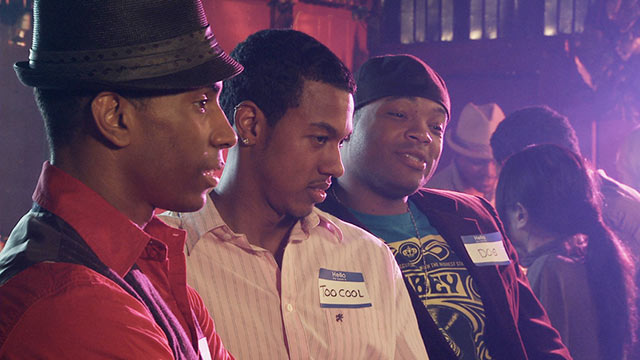
“Speed-Dating” is a funny movie, along the lines of New Zealand’s romantic comedy “Sione’s Wedding.” While not all of the bits seem to connect perfectly (there is definitely the feeling of some scenes existing solely for the jokes contained within them), at least the narrative slides make you laugh. And, you know, if you make a comedy, and you make people laugh, haven’t you succeeded?
I wasn’t 100% onboard with the film’s score, which dips into “Home Alone” territory with some of the music cues, and some of the acting from the non-leads can be pretty painful to watch, though the film does establish an over-the-top style early on that makes the lesser talented actors seem less like they’re trying too hard. I mean, it’s tricky to decipher: is an acting performance poor because the actor is going for over-the-top, or is everyone else just doing over-the-top better?
Overall though, again, “Speed-Dating” is a comedy that is actually funny, and that should be valued highly. While it does dip into the dramatic in a couple moments, it doesn’t misplay its intentions and become melodramatic or tiresome. It could be a little tighter, but the film doesn’t drag and it’s a fun watch.
With Characters Named Too Cool, Dog, and Beaver, Speed-Dating Already Won
by Nick Pinkerton September 29, 2010 / www.villagevoice.com
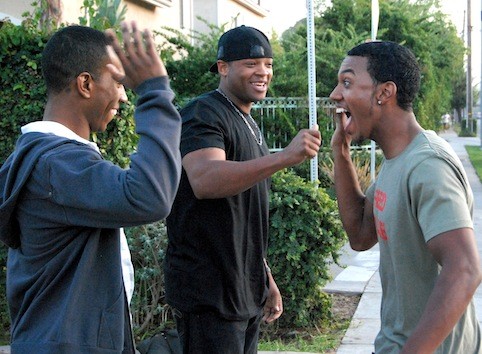
When we meet Too Cool, Dog, and Beaver (Wesley Jonathan, Chico Benymon, and Leonard Robinson), their partnership revolves around trumping up elaborate schemes to find, mate with, and briskly dispose of women. The latest is Speed-Dating’s titular service, which makes for a succession of sexual encounters gone awry—their headquarters, Too Cool’s showroom estate, sees enough one-night-stand traffic to have “Walk of Shame” inscribed over the stairwell. Such cruelty is brushed off as good fun; your entertainment is the only desire of writer/director Joseph A. Elmore Jr., who buys subplots in bulk and drops in music videos when there’s any sign of slowing down. True to bromantic form, the bachelors grow up into true love with nice-looking actresses; along the way, “suspected man-tickler” Beaver confronts obsessively voiced suspicions of same-sex inclinations, there’s some stuff about saving a restaurant, and Too Cool reconciles with his birth mother and senile millionaire aunt (who made her fortune designing HALO!). Tender, meaningful eye contact alternates screentime with cartoon detours, including Chris Elliott as a blue-skinned building inspector named Red Green, Clint “Why not?” Howard hanging around in a wheelchair, Reign Morton queening it up, and stand-up Tony T. Roberts as an ex-pimp pastor. A homemade vaudeville that’s likable enough to wear you down with its eager-to-please capering.
+++
September 28, 2010 | Rating: 2/4
Kam Williams / TheLoop21.com
A titillating tribute to the novel notion of strangers with benefits.
+++

October 21, 2010 | Rating: 1/5
Tim Cogshell / Boxoffice Magazine
Everything about this film is fairly offensive, including its racial stereotypes, homophobia, misogyny, generally bad writing and amateur filmmaking.
+++
October 7, 2010 | Rating: .5/4
Diego Semerene / Slant Magazine
The only thing perhaps scarier than being surprised by the gay monster is, apparently, mistaking a tranny for a real woman.
In Speed-Dating, three buddies engage in that very analog hookup practice in which singles are paired up according to assigned numbers and have a small amount of time to lure their potential mates into bed. Not that Too Cool (the very hot Wesley Jonathan), Dog (Chico Benymon), and Beaver (Leonard Robinson) are Luddites nostalgic for pre-Craigslist modes of cruising, or that straight folk get the sexual technology memo rather late in the game. The group of friends runs the speed-dating soiree as a scheme so that they can handpick the women allowed to participate and control who gets matched up with who.
This system rigged by men, in which women are passed around as stupid, gullible gifts that just keep on giving and heterosexual sex is always some kind of rape has been poetically depicted in Ian McEwan’s novel On Chesil Beach, and philosophically in Gayle Rubin’s essay “The Traffic in Women.” But here all we get is the naturalization of the grotesquerie of that system (“Women are programmed to say no, even if they like you,” Dog warns us), which is played for laughs.
Speed-Dating is that type of vile cultural product that adds more fuel to a mediascape already saturated with sexism travestied in mere horniness. It’s invested in the same project—excusing heterosexual males’ objectification of women as a commendable and natural necessity—as something like The Hangover or Old School. The filmmakers seem aware of how ghastly heterosexual courtship can be, Beaver saying at one point: “We scheme on women in order for them to feel better about being disrespected.” Yet the film’s sole preoccupation is to reassert the biological imperative that men will be boys, immune to human feeling, perennially erect and made whole by indecent amounts of cash, and that it’s women’s job to sit around looking pretty until men decide to put their Xbox aside and surrender to love.

The film’s most recurrent, and dullest, motif is its barrage of gay jokes, which are mostly projected onto Beaver, the kind of homophobic fantasy that is summoned when homosexual desire isn’t properly sublimated onto homoerotic activity—such as bromances or contact sports. Have straight men not found other creative ways of attesting their sexual identity without reasserting gayness as some kind of invisible time bomb, a sly Sphinx lurking inside, ready to storm out and castrate everybody? Apparently one is safe if he is the first to recognize this sneaky queer demon, which must be why Dog points out Beaver’s supposed gayness every other scene. After Beaver finally goes “gay,” at a club filled with horny gay men ready to eat alive any straight men who dare walk in, he spends the rest of his screen time wearing short shorts, midriff-baring knotted T-shirts, and hosting pool parties. The film can’t even accept its own logic, though, making Beaver realize, post-flaming out and all, that he cannot bring himself to kiss another man and, therefore, wasn’t truly gay all along. How could one be gay, really, with so many beautiful women in the world?
The only thing perhaps scarier than being surprised by the gay monster is, apparently, mistaking a transsexual for a real woman—though promptly realizing it before the deed is done. Which happens at least twice in the film. Speed-Dating also elects the physically impaired and little people as the butt of its “jokes.” By the time it tries to find dramatic gravitas, introducing a storyline about an adopted son searching for his birth mother (to the sound of Hallmark-esque piano notes), you don’t know if you barf from the saccharine or from the meta-minstrelsy. While the women for consumption on display come in different shapes, sizes, and races, the local club appears as the only space for sociality for African-American men, who turn taking advantage of women’s bodies and women’s bank accounts (they live off of a rich aunt suffering from Alzheimer’s) into their fulltime job.
Rotten Tomatoes Audience Reviews
Milton D
***½ December 24, 2012
good movie, once again the critics crucify a good movies. every entertaining, but the blue guy is a little cheesy. Holly has a special appearance in this one; two scenes. i really enjoyed this one. great value for $1.
+++
David J
½* April 11, 2012
Probably the most painful movie I had to suffer through. I had to watch it in intervals over a period of 3 days.
+++
Dorothy H
***½ November 17, 2011
This movie was actually really funny. It was entertaining and the story line moved at a pretty good pace.
I got my shorts shorts on.
+++
Thomas P
**½ September 4, 2011
Not bad. Pretty cool for a low budget. It actually has a pretty decent storyline.
+++
Stacks A
*½ August 7, 2011
hot women but some bullshit lol
+++
Milton D
***½ July 4, 2011
good movie, once again the critics crucify a good movies. every entertaining, but the blue guy is a little cheesy. Holly has a special appearance in this one; two scenes. i really enjoyed this one. great value for $1.
+++
Alison G
***April 3, 2011
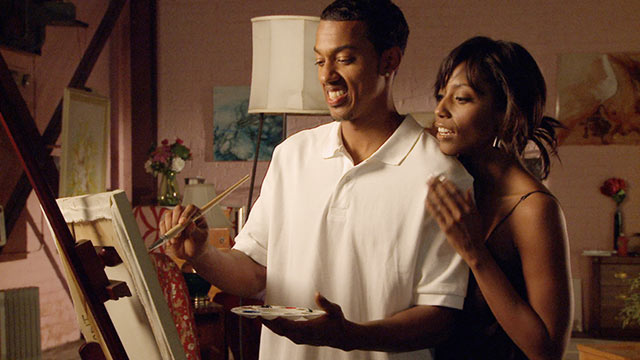
Cheesy, corny. You get what you expect from a name such as this movie lol Entertaining and amusing to say the least. Nothing to write home about apart from the 2 main girls are hot :)
+++
Ole J
½* February 4, 2011
Bad movie, I thought it at least would have some fun, but most of all its trash, with a couple of old timers from 80-90 series etc.
I'll give it half a star for the effort, but it just tries to hard to be fun and to please the viewers.
+++
Michael G
***½ June 17, 2010
I think this movie was worth seeing. This Heroe is a cool ladies man who seems to have it all together but is all well beneath the surface? There's lot's of comedic hijinx and slapstick but a real serious tone is struck When the heroe's personal life and fears of being alone continue to haunt him. I think everyone can relate with the heroe's loneliness, love issues and the struggle to figure out who and what real friends and family are.
An Interview with Wesley Jonathan
Posted by robsmith on Oct 7, 2010 / www.blackfilm.com/
Distributor: Rockstone Releasing
Director: Joseph A. Elmore, Jr.
Screenwriter: Joseph A. Elmore, Jr.
Producer: Mekita Faiye
Cast: Wesley Jonathan, Chico Benymon, Mekita Faiye, Leonard Armond Robinson, Vanessa Simmons, Holly Robinson Peete, Nick Chinlund
Genre: Comedy
MPAA Rating: PG-13
Find Out Why Wesley Jonathan Is TOO COOL!
Many may remember him as the curly haired kid from “City Guys” and “What I Like About You”, but Wesley Jonathan has been around since the days of “21 Jump Street”, “A Different World” and “Thea”. With a lengthy resume and a producing credit under his belt, Jonathan says the one word that would describe him in this business is consistent.
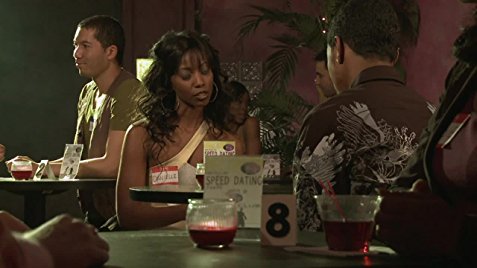
A native of Los Angeles, Jonathan is far from a new comer and spoke about what keeps him focused in this business, which he has grown to love. Jonathan portrays the womanizing Too Cool in “Speed-dating” which was released in limited theaters October 1st.
What attracted you to this film?
Wesley Jonathan: The script. I read it and it was funny. I went in to audition for it then walked away and went about my daily business. They ended up calling and saying they wanted me to come in for another role. Many months later, after I had completely forgotten about this movie, I got a call from my agency saying do you remember the movie “Speed-Dating”? They want to offer you the lead role. I was like I’ll need to read the script again. When you read scripts all day you tend to forget what’s what. So I ended up reading the script again. It made me laugh-out-load at moments. To make a long story short I said I’ll do it but of course I asked them whom they already had in it. There were some people that I knew, who were actually friends of mine that I’ve worked with before. That attracted me as well. It was funny and the fact that some recognizable faces and friends were a part of the film helped.
So how was it being able to reunite with people you’ve worked with before and working with the cast of Speed-dating in specific?
Wesley Jonathan: It was fun. It’s always fun when you know peoples work, you know their style and you know them. It was fun!
Were there any similarities you discovered between yourself and your character Too Cool?
Wesley Jonathan: We all like to think that we’re cool. My character was a “character”. Over the top! You know, you’re young and love women but there’s a fine line between Too Cool and me. But that would be the closest similarity, lol.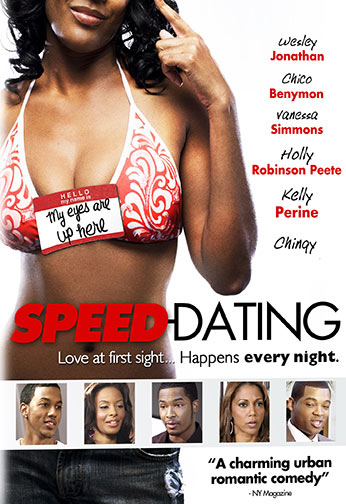
Are you happy to hear that the film is going to hit theaters instead of going straight to DVD?
Wesley Jonathan: Am I happy? I’m more shocked to be honest with you. I admire Makita’s hustle and how she got that done. I’m definitely shocked. Am I happy to be in this black film and it’s going to be put into theaters? Yeah. Great. I know it will help us as independent black filmmakers, so yeah, of course.
You’ve been in the business for quite awhile. What’s been the most challenging aspect of staying in the game for you?
Wesley Jonathan: Doing it for so long, I guess it takes a toll on you as a person, the spirit and the soul. Just everything. This business is so crazy. People may say you’re not an A-list actor or you’re not this and you’re not that but the one thing I am that I can say and kind of pat myself on the back for being is pretty consistent. A word to describe me in this business is longevity. I’ve been doing it for so long. It’s a job to me. It’s what I do and what I enjoy doing big scale or small scale. The motivation to continue to move people! If I make you laugh, if I make smile, if I make you cry, if I make you angry with whatever characters I’m playing then I’m doing my job. That’s probably one of the most rewarding things. To move people in any way, shape or form. It doesn’t necessarily have to be in a positive way. If you look at the character I played and say “Oh God, I hated you in that movie!” Well great. You were moved. You were affected. I did my job. That’s a big part of it.
What’s next for you?
Wesley Jonathan: I just Associate Produced a film called “Dysfunctional Friends” starring Stacy Dash, Terrell Owens, Reagan Gomez, Hosea Chanchez, Persia White, Jason Weaver and myself. There are cameos by Meagan Good and Antwon Tanner from “One Tree Hill”. Essence Atkins does a cameo for us. Vanessa Simmons, who is also in “Speed-Dating”, did me a favor and jumped on in there. I’m missing so many people. It’s just a really great cast. Christian Keyes of the Tyler Perry plays and Stacy Keibler. So many people! I’m really excited about this movie. I’ve seen rough cuts of it already. The movie is about Keith Robinson. We all are college friends who were really close at one time and as we get older and move on with our lives we lose contact. Keith Robinson’s character dies and leaves a portion of his estate to us. His friends. In order for us to get this money, we are ordered by him to reconnect and to stay together in this mansion for a weekend to rekindle and jump-start our friendships. All kinds of stuff hits the fan. Truth. Scandal. All kinds of crazy things take place. “The Breakfast Club” meets “The Big Chill”. I also have a national Miller Light commercial that’s coming out during the football season. I have another independent film called “B-Girl” that’s running on Showtime right now and a film that I did about 7 or 8 years ago called “Steppin” that’s running on BET like crazy.
So you produced this film that’s coming up. Is producing something you’re looking to get into?
Wesley Jonathan: Not in that position. I would rather direct or do camera work. Producing? I’ve gotten a taste of what that really is and I’m not that crazy about it personally. I’ve seen it done. I saw what Makita goes through and went through. I see what a lot of Producers go through. Not exactly something that I’m eager to do or love to do. I would rather direct. Producing is a pain in the butt. I have a different respect for Producers now. The business kind of forces you to do that. If I had it my way I would direct or be in front of the camera doing what I’m doing. That’s were my happiness is. Producing is something I was kind of forced to do trying to get my own stuff going.

More Background On Speed-DatingMovie.com
Speed-DatingMovie.com functioned as the official online hub for the 2010 ensemble comedy Speed-Dating, a modestly budgeted but energetically marketed film that aimed to capture the raunchy, fast-talking spirit of late-2000s bromantic humor. While the theatrical footprint of the movie was limited, the website became an important gathering point for trailers, cast information, promotional materials, and press reactions. In the years since the film’s release, archived versions of the site have taken on a second life as a record of how independent distributors used the web to compete for attention in a crowded marketplace.
At its height, the site balanced standard promotional fare—synopsis, credits, and video clips—with a personality that mirrored the movie’s swagger. Visitors were encouraged to meet the characters, watch exclusive media, and follow the journey of a group of friends who believed they had perfected a system for gaming romance. That mix of cheekiness and hustle reflected the filmmaking ethos behind the production itself.
The Film Behind the Domain
Written and directed by Joseph A. Elmore Jr., Speed-Dating followed three bachelors—Too Cool, Dog, and Beaver—who organize sham dating events so they can profit while cherry-picking potential partners. What begins as a string of conquests evolves into familiar romantic-comedy complications when genuine feelings intrude.
The cast brought together recognizable faces from television and urban-market comedies, including Wesley Jonathan, Chico Benymon, Leonard Robinson, and appearances by performers such as Holly Robinson Peete and character-actor favorite Chris Elliott. Distribution was handled by Rockstone Releasing, which specialized in targeted theatrical runs followed by a quick transition to home media.
For visitors to the website, these names mattered. Independent features often rely on the familiarity of TV alumni and cult performers to attract audiences, and the marketing leaned into that recognition factor.
Launch Strategy and Online Presence
When the film opened in 2010, the industry was in a transitional moment. Social media had not yet fully replaced official websites, and a movie’s domain still served as the primary source of authoritative information. Speed-DatingMovie.com offered downloadable posters, a red-band attitude, and embedded trailers that could be shared across blogs.
Archived snapshots show a design language common to the era: bold fonts, nightlife imagery, and a promise of unapologetic fun. Rather than attempting prestige, the site sold immediacy—laughs, attractive leads, and outrageous situations.
Story, Tone, and Comic Influences
The humor in Speed-Dating positioned it alongside titles that emphasized male friendship, sexual bravado, and the tension between carefree living and emotional maturity. Yet, unlike studio productions with similar themes, this film operated without the safety net of massive marketing budgets. The official site therefore had to communicate tone quickly: outrageous, cartoonish, and knowingly excessive.
Clips and copy highlighted slapstick, verbal sparring, and broad caricature. Even the obstacles facing the heroes—licensing issues, romantic misunderstandings, meddling authority figures—were presented as setups for punch lines. The aim was clear: convince audiences they would laugh early and often.
Reception and the Split Between Critics and Viewers
One of the most interesting aspects preserved through the site and later archival material is the sharp divide in reception. Professional critics frequently objected to the movie’s reliance on stereotypes and shock humor, while many audience reviewers praised it as lightweight entertainment that delivered value for money.
The contrast became part of the film’s identity. For supporters, negative criticism signaled that the movie was gleefully unconcerned with refinement. For detractors, it confirmed suspicions that the humor punched down. Speed-DatingMovie.com did not attempt to mediate that argument; it simply amplified the party atmosphere and let viewers decide.
Interviews, Publicity, and Cast Narratives
Press coverage surrounding the release often focused on the career trajectory of Wesley Jonathan, whose résumé stretched back to teen television of the 1990s. In interviews he described being drawn to the script’s energy and the camaraderie of working with friends. Those human-interest angles were valuable to the website because they reframed the production as a labor of love within a tight creative community.
Such narratives helped audiences see the film not merely as a crude farce but as a stepping stone for artists building sustainable careers in entertainment.
Independent Distribution Realities
For a company like Rockstone Releasing, success did not necessarily mean blockbuster numbers. Instead, profitability depended on targeted marketing, controlled expenses, and strong afterlife performance on DVD and cable. The official website played a crucial role in that model, acting as a digital brochure long after theatrical listings expired.
In this sense, Speed-DatingMovie.com outlived the opening weekend. It continued to inform potential renters, journalists, and fans who discovered the film years later.
Cultural Context
The late 2000s and early 2010s were saturated with comedies about extended adolescence. Films explored the fear of commitment, the confusion of modern dating, and the rituals of nightlife. Speed-Dating fit squarely within that trend, albeit from a perspective centered on African-American social spaces that were underrepresented in mainstream romantic comedies at the time.
That specificity contributed to the loyalty expressed by some viewers, who appreciated seeing familiar environments and comedic rhythms on screen.
The Website as Archive
Today, the domain’s greatest importance may lie in preservation. Through archived captures, researchers can study how indie films marketed themselves before streaming platforms dominated discovery. Layouts, taglines, and video formats reveal assumptions about audience behavior: people would browse, read cast bios, and watch Flash-based trailers on desktop computers.
The survival of these materials helps reconstruct a chapter of digital film culture that might otherwise vanish.
Audience Memory and Word of Mouth
User reviews over the years show a pattern common to cult titles. Some viewers returned repeatedly, recommending the film to friends and emphasizing its quotable lines. Others warned newcomers away. That friction kept conversation alive, and the website served as a neutral stage on which enthusiasm and rejection could coexist.
Performers Beyond the Film
Several actors leveraged the visibility of Speed-Dating into additional independent projects, television appearances, and producing opportunities. Interviews from the period reveal ambitions that stretched well beyond a single movie. For fans exploring those careers, the website provided a starting point.
Music, Style, and Atmosphere
Another selling point frequently mentioned in commentary was the film’s party vibe—bright costumes, nightclub settings, and an anything-can-happen momentum. Promotional materials foregrounded this atmosphere, inviting audiences to treat the experience less like narrative cinema and more like a social event.
Legacy
While Speed-Dating never transformed into a mainstream franchise, it occupies a recognizable niche within early-2010s urban comedies. Speed-DatingMovie.com remains a testament to the optimism of that moment, when a dedicated site could give a modest production national visibility.
The endurance of its archived pages demonstrates how even small films contribute to the broader ecosystem of movie history. They showcase evolving tastes, debates about representation, and the entrepreneurial strategies filmmakers used to reach audiences.
Speed-DatingMovie.com was more than advertising. It was a handshake between creators and viewers, a declaration that this loud, imperfect, energetic comedy deserved attention. Whether one regards the movie as outrageous fun or a relic of less enlightened humor, the website captures the ambition behind bringing it to the screen.
For historians of independent cinema and digital promotion alike, that makes the domain worth remembering.